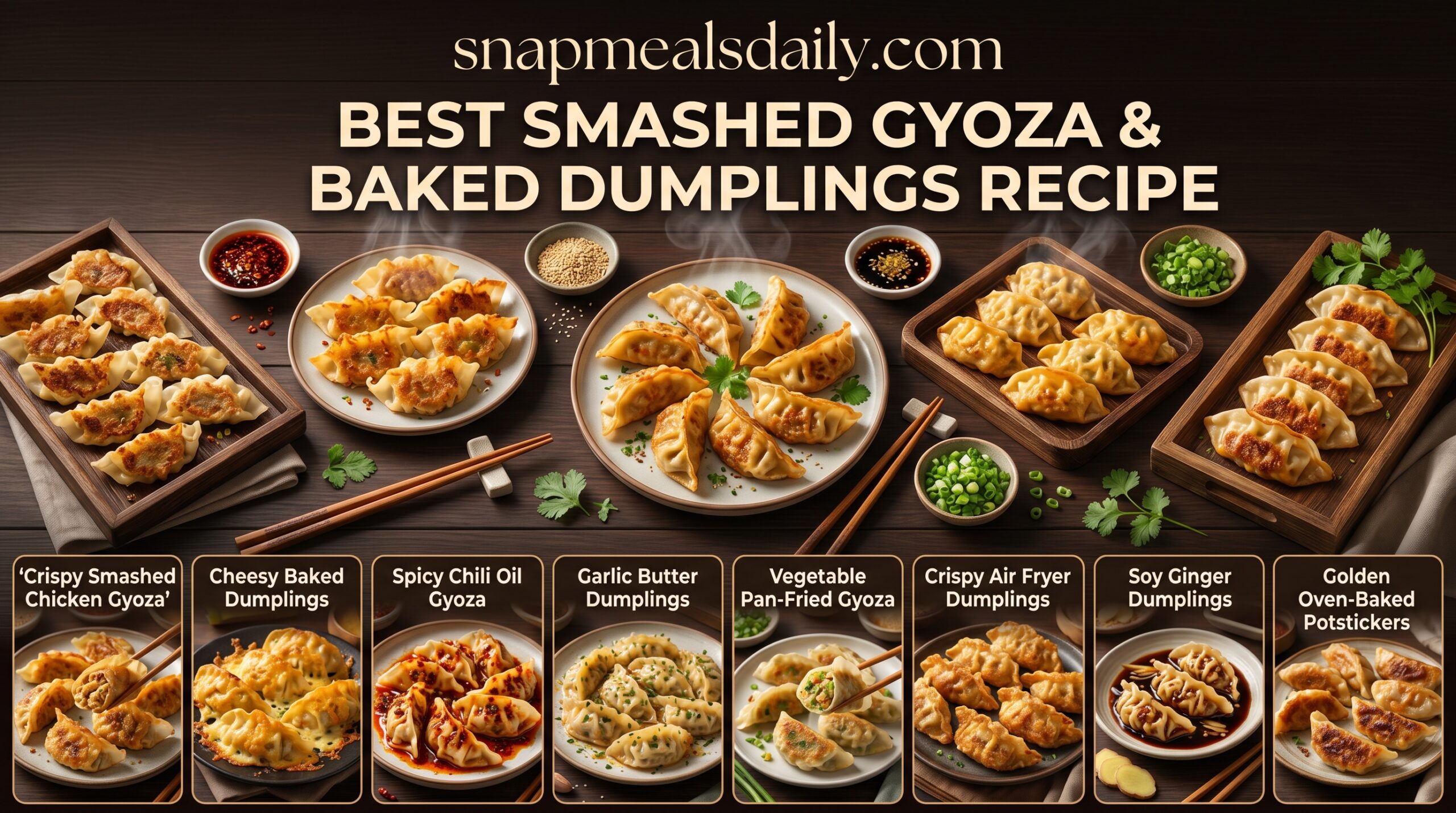
Learn how to make viral smashed gyoza and baked dumplings at home — ultra-crispy, golden, and ready in 25 minutes. Includes coconut curry dipping sauce recipe and pro tips.
Smashed Gyoza & Baked Dumplings:
The Crispy Revolution You Need to Try
Smashed gyoza deliver bold flavour, irresistible crunch, and restaurant-style comfort food straight to your kitchen. This viral food trend transforms simple dumplings into crispy golden bites with the perfect crunchy texture in every bite.

Home cooks across TikTok and Instagram cannot stop making these crispy dumplings because they get incredible results with very little effort. You only need a hot pan, frozen dumplings, and a few simple ingredients to create something unforgettable. Whether you love Japanese-inspired recipes or quick comfort meals, smashed gyoza deserve a place on your weekly menu for easy lunches, dinners, and party snacks.
What Exactly Are Smashed Gyoza?
Gyoza represent the Japanese version of the classic Chinese dumpling (jiaozi). People traditionally pan-fry them to create a crispy bottom while the top stays tender and steamed. However, people also call smashed gyoza smashed dumplings or baked dumplings, and this version takes the concept a bold step further.
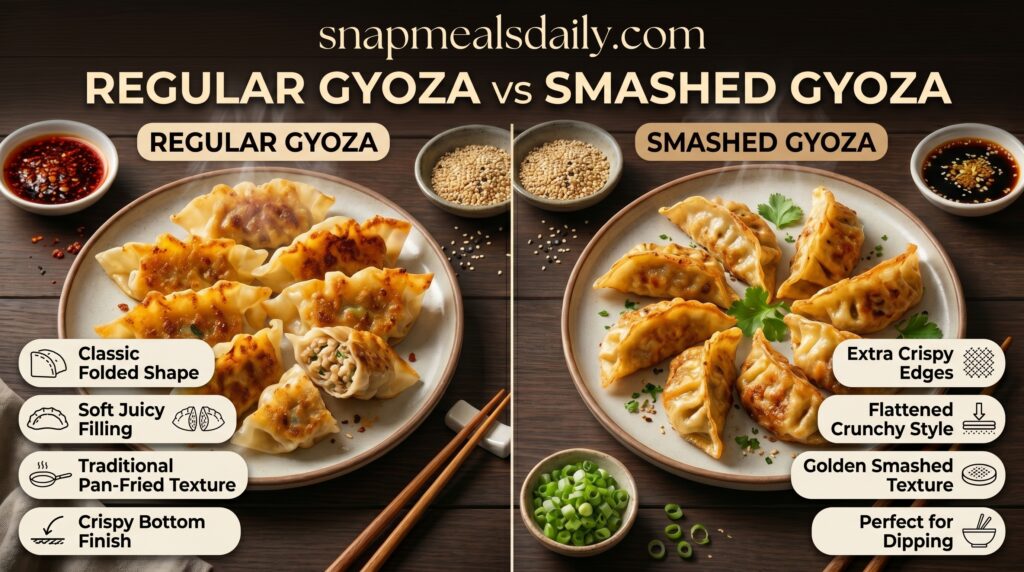
The technique feels deceptively simple. After a brief initial cook, you press (or smash) the dumplings flat with a spatula or heavy pan, and this dramatically increases the surface area that touches the hot pan or oven. This creates a result with almost the entire surface covered in a shatteringly crisp, lacy, golden-brown crust — much more than traditional gyoza ever achieve.
This small change in method creates a completely different eating experience. A classic gyoza gives a crispy bottom with a soft, chewy top, while smashed gyoza deliver crunch in nearly every single bite. Food writers describe smashed gyoza as a game-changer and addictive, and they say these dumplings are something people never knew they needed.
The smash technique works for dumplings the same way smash burgers work for beef patties — it reveals a simple idea that already exists in plain sight.
The Origin Story: Where Did This Trend Come From?
Like many great food trends, smashed gyoza come from blurry, overlapping origins. Asian cooks have used smashing techniques in their cooking traditions for years. They press tofu, smash cucumbers, and flatten meats, and these methods play a strong role in Chinese and Japanese culinary culture. However, the viral moment arrived when home cooks and food content creators on TikTok and Instagram started filming the satisfying press-and-sizzle of dumplings as they squashed them flat in a hot pan.
TikTok creators spread these sizzling dumpling videos across social media within weeks. The dramatic sizzling visuals attract millions of social media users. By early 2025, food lovers push smashed gyoza to the top of Google recipe searches.
Restaurant chefs quickly follow suit. Upscale Asian fusion restaurants start putting smashed gyoza on menus with elevated fillings such as truffle pork, spicy tuna, and kimchi cheese. Street food vendors begin selling them by the bag. Home cooks also discover that they can make them easily with frozen store-bought dumplings — no special skills required.
Gyoza vs. Dumplings: What’s the Difference?
- Gyoza — Japanese-style dumplings with thinner wrappers, usually filled with pork, cabbage, garlic, and ginger. Traditionally pan-fried (yaki-gyoza).
- Jiaozi — Chinese dumplings with slightly thicker wrappers. Can be boiled, steamed, or pan-fried.
- Potstickers — The American term for pan-fried dumplings, similar to gyoza.
- Baked Dumplings — Any of the above cooked in an oven instead of a pan, often with oil to achieve crispiness.
- Smashed Dumplings — Any dumpling variety that is pressed flat during cooking for maximum crispiness.

The Science Behind the Crunch: Why Smashing Works
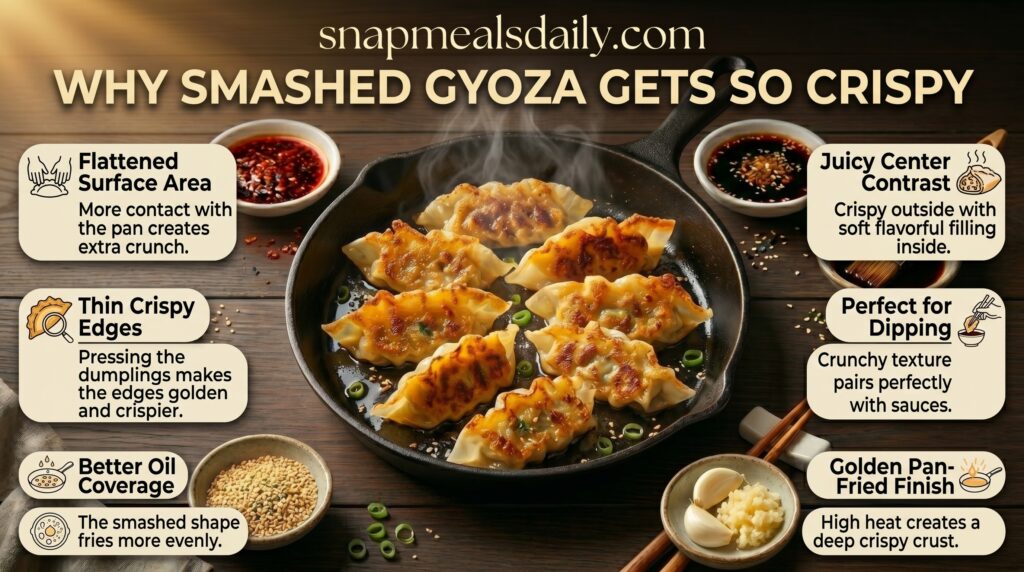
The reason smashed gyoza feel so satisfying comes from basic food science. When you flatten a dumpling, you increase its surface area and create more contact with the hot cooking surface. More surface area produces more of the Maillard reaction — a chemical process that creates a golden-brown colour and a rich, nutty, slightly caramelised flavour that makes crispy food so irresistible.
Smashing also releases some moisture from the filling, and that moisture evaporates quickly in the heat. This creates steam pockets that make the wrapper even lighter and crispier. The thin edges turn into crispy, chip-like bites, while the centre keeps the filling juicy.
When you add a starch slurry (a mixture of water and cornstarch or flour), the effect becomes even stronger. As the water evaporates, the starch forms a thin, crackly, web-like crust that connects the dumplings and turns the entire pan into one giant crispy dumpling skirt. This method follows the same technique as the famous dumpling skirt or crispy lace style that went viral a few years earlier.
Smashed Gyoza vs. Baked Dumplings: Two Delicious Paths
Food creators often use the terms smashed gyoza and baked dumplings interchangeably. Understanding both will help you choose the right approach for your kitchen and situation.
Smashed Gyoza (Pan Method)
- Done in a skillet or frying pan
- Faster — ready in 10–15 minutes
- More hands-on, requires watching
- Delivers the most intense crunch
- Best for 6–12 dumplings at a time
- Great for weeknight dinners
Baked Dumplings (Oven Method)
- Done in an oven at high heat (220°C/425°F)
- Hands-off — set and forget
- Consistent crispiness all around
- Can make large batches easily
- Perfect for meal prep or parties
- Slightly less crispy than pan method

The Viral Variation: Coconut Curry Baked Dumplings
One recipe particularly captured the internet’s attention. This fusion creation takes the baked dumpling technique and pairs it with a rich, fragrant coconut curry dipping sauce — or in some versions, actually infuses the curry flavour directly into the cooking process.
The bold curry flavours balance the rich crispy wrapper and savoury filling perfectly. It’s bold, comforting, and unexpectedly elegant. Several food bloggers call it the best dipping sauce pairing for dumplings.
You can easily adapt the recipe with different curry pastes and flavours. You can use any store-bought curry paste — Thai red, Thai green, Japanese golden curry, or an Indian-style tikka masala paste all work beautifully. Simply whisk it with coconut milk, a splash of lime juice, and a little fish sauce or soy sauce for depth, and you have a dipping sauce that elevates any dumpling into something truly special.

Complete Recipe: Smashed Gyoza with Coconut Curry Dipping Sauce
Prep Time10 minutes
Cook Time15 minutes
Serves2–3 people
DifficultyEasy
Calories~380 per serving
Ingredients — Dumplings
- 16–20 frozen or fresh gyoza / dumplings (pork, chicken, or vegetable)
- 3 tablespoons neutral oil (vegetable, sunflower, or avocado oil)
- 3 tablespoons water
- 1 teaspoon cornstarch (for the crispy skirt)
- 1 tablespoon soy sauce (for brushing, optional)
- 1 teaspoon sesame oil (for finishing)
- Sliced spring onions and sesame seeds to garnish
Ingredients — Coconut Curry Dipping Sauce
- 3 tablespoons coconut milk (full fat, shaken)
- 1.5 tablespoons Thai red or green curry paste
- 1 tablespoon soy sauce or fish sauce
- 1 teaspoon lime juice (fresh)
- 1 teaspoon honey or palm sugar
- ½ teaspoon grated fresh ginger
- Pinch of chilli flakes (optional)
Method — Step by Step
- Make the sauce first: Whisk together all dipping sauce ingredients in a small bowl until smooth. Taste and adjust — add more lime for brightness, more curry paste for heat, more honey to balance. Set aside.
- Mix the slurry: In a small cup, mix the water and cornstarch together until fully dissolved Set aside.
- Heat your pan: Place a large, flat-bottomed non-stick skillet over medium-high heat. Add the oil and let it get hot — about 1–2 minutes. Heat the oil until it starts shimmering but avoid smoking.
- Add dumplings: Place the dumplings in the pan in a single layer with a little space between each. Let them fry untouched for 2 minutes until the bottoms begin to turn golden.
- Smash them: Using the flat bottom of a heavy spatula, a small saucepan, or a burger press, firmly press each dumpling flat. Press the dumplings until they reach about 1–1.5cm thickness. Work quickly so they all get pressed while still pliable.
- Add the slurry: Pour the cornstarch-water slurry around and over the dumplings. The hot pan creates an aggressive sizzling sound immediately. Immediately cover the pan with a lid and steam for 3 minutes.
- Remove the lid and crisp: Take the lid off and cook for another 3–4 minutes until all the water has evaporated and the dumpling skirt is deeply golden and crisp. If using soy sauce, brush it on now for extra colour and flavour.
- Finish and serve: Drizzle with sesame oil, scatter over spring onions and sesame seeds. Slide the whole crispy skirt onto a serving plate in one glorious piece. Serve immediately with the coconut curry dipping sauce on the side.
How to Nail It: Pro Tips from the Best Smashed Gyoza Makers
Top Tips for Perfect Results
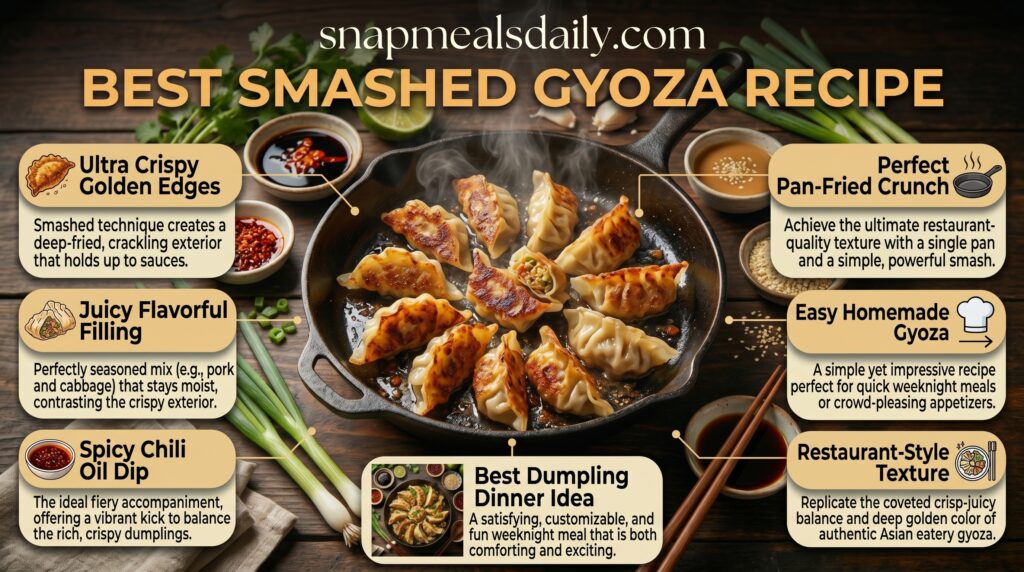
- Don’t thaw frozen dumplings first. Cook them straight from frozen — they hold their shape better during the smash and the steam from the ice helps cook the filling through.
- Use a flat-bottomed pan. Cast iron or a heavy non-stick skillet gives the most even heat distribution and the best crust.
- The slurry is non-negotiable. That cornstarch-water mix is what creates the magical lacy skirt. Don’t skip it or substitute plain water.
- Smash confidently and quickly. Press each dumpling firmly and quickly to create an even crispy texture. Press firmly and hold for 3–5 seconds on each dumpling.
- High heat = maximum crunch. Don’t be afraid of a hot pan. The pan should produce a loud aggressive sizzle.
- Serve immediately. Smashed gyoza lose their crispiness quickly. Have everything ready before you start cooking.
- Use frozen gyoza from Asian supermarkets for the best results — they have better wrapper-to-filling ratios than many Western supermarket brands.
The Best Fillings for Smashed Gyoza
While you can absolutely smash any store-bought dumpling, if you’re making your own filling from scratch, Certain filling combinations create the best crispy texture and flavour.
Classic Pork and Cabbage
The traditional and arguably the best: ground pork, finely shredded napa cabbage (salted and squeezed dry), garlic, ginger, soy sauce, sesame oil, and a touch of rice wine or sake. The pork fat keeps the filling juicy while the wrapper turns crispy and golden.
Chicken and Lemongrass
A lighter option that pairs wonderfully with the coconut curry sauce. Ground chicken, finely minced lemongrass, ginger, garlic, fish sauce, and lime zest. Fragrant, bright, and perfectly balanced.
Kimchi Pork (The Trendy Option)
Finely chopped kimchi mixed with ground pork, gochujang, garlic, and spring onions. Heat intensifies the fermented kimchi flavour and creates a bold spicy filling.
Vegetarian: Tofu, Mushroom, and Edamame
Crumbled firm tofu, finely diced shiitake mushrooms, edamame, garlic, ginger, soy sauce, and a good amount of sesame oil. Press the tofu well before using to remove excess moisture — vital for a non-soggy result.
Coconut Curry Chicken (Fusion)
Ground chicken mixed directly with a tablespoon of red curry paste, coconut cream, lime leaves, and ginger. A filling that echoes the dipping sauce and creates an intensely cohesive flavour experience throughout.
Baked Dumpling Method: The Hands-Off Alternative
Choose the baked dumpling method when you need large batches. Preheat your oven to 220°C (425°F / Gas Mark 7). Line a baking tray with parchment paper and brush it generously with oil.
Arrange your dumplings on the tray — no need to smash beforehand. Brush the tops with a mix of soy sauce and sesame oil. Bake for 18–22 minutes, flipping halfway, until deeply golden on both sides. For the crispy skirt effect, mix 2 tablespoons of water with 1 teaspoon of cornstarch and pour around the dumplings halfway through cooking, then return to the oven.
This method creates crispy dumplings with very little effort and works perfectly for large batches.

What to Serve With Smashed Gyoza
You can serve smashed gyoza and baked dumplings as starters, snacks, or full meals. Here are the best pairings:
- Coconut curry dipping sauce (as above) — the 2025 go-to combination
- Classic ponzu — citrusy soy-based dipping sauce, light and bright
- Chilli crisp (like Lao Gan Ma) — spicy, oily, umami-packed; incredibly addictive
- Sesame ginger sauce — toasted sesame, fresh ginger, rice vinegar, and soy
- Miso soup — for a complete Japanese-inspired meal
- Simple Asian slaw — shredded cabbage, carrots, sesame oil, and rice vinegar
- Steamed jasmine rice — for a more substantial meal
Why This Trend Is Here to Stay
Some food trends burn bright and fade fast. Smashed gyoza is not one of them. People love smashed gyoza because the technique creates better crunch, flavour, and texture the technique works, the results are genuinely superior to standard pan-fried dumplings, and the barrier to entry is almost zero. You need one pan, some oil, a spatula, and a bag of frozen dumplings that costs next to nothing.
The technique helps beginners create restaurant-style crispy dumplings at home. The visual drama of the smash, the sizzle of the slurry, the unveiling of the crispy skirt — it’s theatrical cooking that produces restaurant-quality results in your own kitchen.
Social media helped smashed gyoza reach millions of home cooks around the world. This technique genuinely improves flavour, texture, and crunch.
The smash is not a trick. It’s a technique. And like all great techniques, once you learn it, you’ll wonder how you ever cooked without it.
Conclusion
Smashed gyoza deliver everything people want from a modern comfort food recipe: bold flavour, crispy texture, and quick preparation. This viral dumpling trend turns simple ingredients into a restaurant-quality meal. You can prepare smashed gyoza with pork, chicken, vegetables, or creative fusion fillings and still enjoy that irresistible golden crunch.
The coconut curry dipping sauce adds even more flavour and makes every bite unforgettable. Whether you cook them in a skillet or bake them in the oven, smashed gyoza bring fun, crunch, and comfort straight to your table with very little effort or cooking experience required.